

Ottawa’s real estate market showed some signs of improvement in October, with home sales increasing slightly and fewer new properties entering the market. While conditions continue to favour buyers, the latest numbers suggest that some of the pressure on sellers may be starting to ease as the market moves toward the winter season.
Although sales remain below where they were at this time last year, the increase from September, combined with a decline in new listings, helped bring the market into somewhat better balance. Inventory levels also decreased month over month, offering a little more encouragement for sellers.
That said, buyers still have plenty of properties to choose from, and pricing remains an important consideration for anyone preparing to enter the market.
Ottawa Home Sales in October 2026
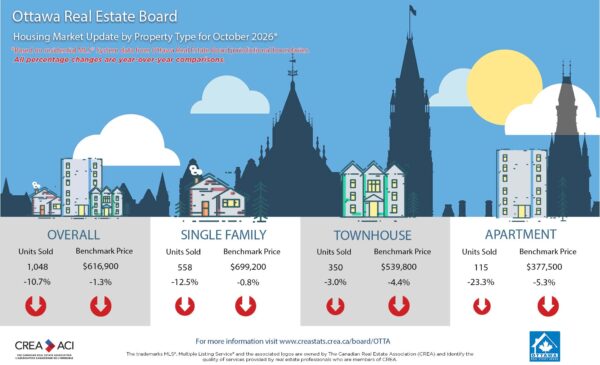
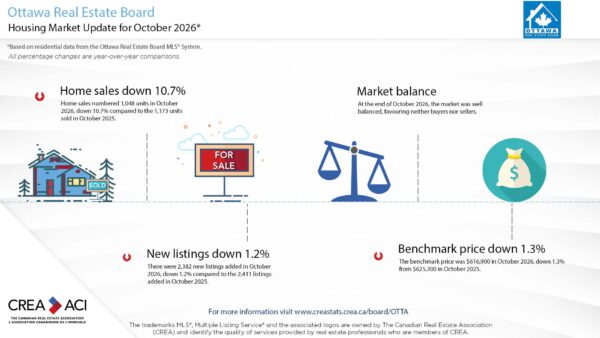
According to the Ottawa Real Estate Board (OREB), 1,048 residential properties sold through the MLS® System in October. This represents a 10.7% decrease compared with October 2025, but a 3.8% increase from September.
Looking at the different property categories, sales were lower across the board compared with last year:
- Detached and single-family homes: 558 sales, down 12.5%.
- Townhomes: 350 sales, down 3.0%.
- Condominiums and apartments: 115 sales, down 23.3%.
While the monthly increase in sales is encouraging, overall activity remains relatively subdued compared with previous years. October recorded the third-lowest number of sales for the month since 2016.
For the first 10 months of 2026, Ottawa recorded 11,335 residential sales, representing a 7.3% decline from the same period last year. The total dollar value of those transactions was approximately $7.9 billion, down 8.0%.
New Listings and Housing Inventory
One of the more notable changes in October was the reduction in new listings.
There were 2,382 new properties listed for sale during the month, down 1.2% compared with October 2025 and 18.6% from September.
Despite the monthly decrease, new listing activity remains relatively high by historical standards. October’s total was 26.1% above the 10-year average for the month, indicating that buyers continue to have a substantial selection of homes available.
Breaking down the numbers:
- Single-family homes: 1,202 new listings, up 1.3% year over year.
- Townhomes: 740 new listings, up 1.9% year over year.
- Apartments and condos: 367 new listings, down 10.9% year over year.
By the end of October, there were 4,582 active residential listings across Ottawa. This was a 4.8% decrease from September, although inventory remained 6.4% higher than October 2025.
For buyers, this means there are still opportunities to explore different neighbourhoods, property styles and price ranges. Sellers, meanwhile, are competing in a market where pricing, presentation and marketing continue to play an important role.
Ottawa Home Prices: Where Does the Market Stand?
Home prices experienced another modest adjustment in October.
The average residential sale price in Ottawa was $678,512, down 4.5% compared with October 2025 and 1.0% from September.
The median sale price was $622,000, representing a 3.9% year-over-year decrease and a 0.5% decline from the previous month.
Another useful measure is the MLS® Home Price Index (HPI), which tracks the value of homes with consistent characteristics over time. Ottawa’s composite benchmark price was $616,900 in October, down 1.3% from last year and 1.1% from September.
While prices have softened, the pace of decline appears to be slowing slightly. After accounting for seasonal influences, the benchmark index decreased approximately 0.5% in October, compared with a 1.5% decline in September.
Homes also sold for an average of 97.5% of their original asking price, unchanged from September. The median time a property spent on the market was 25.5 days, compared with 27 days the previous month.
For sellers, these figures reinforce the importance of entering the market with a realistic asking price. Buyers are taking their time, comparing available options and negotiating more carefully than they might in a highly competitive market.
How Are Different Property Types Performing?
Not every segment of Ottawa’s housing market is experiencing the same conditions.
Single-Family Homes
Detached and single-family properties continue to show relatively balanced market conditions. October ended with approximately 4.0 months of inventory, while the benchmark price was $699,200, a 0.8% decrease compared with the same time last year.
Townhomes
Townhomes remain one of the stronger segments of the market. Inventory stood at 3.6 months, with a benchmark price of $539,800. This represents a 4.3% decrease year over year.
Condominiums and Apartments
The condominium market continues to face the greatest amount of pressure. October recorded 7.4 months of inventory, slightly higher than September’s 7.3 months and considerably above the 5.8 months recorded one year ago.
The apartment benchmark price was $377,500, down 5.3% from October 2025 and 0.9% from September.
Higher inventory and softer pricing are creating more opportunities for condominium buyers, while sellers may need to be particularly mindful of comparable listings and recent sales when determining their asking price.
A Closer Look at Ottawa’s Neighbourhood Markets
Ottawa’s suburban communities continued to account for the majority of real estate transactions in October. A combined 753 properties sold across the east, west and south suburban markets, representing approximately 72% of all residential sales.
However, sales in each of these areas were lower than they were in October 2025.
When comparing inventory levels across Ottawa’s different regions, suburban neighbourhoods generally continued to experience stronger conditions than the central and rural markets.
Ottawa’s East Suburbs had the lowest inventory level at 3.5 months, followed by the West Suburbs at 3.7 months and the South Suburbs at 4.1 months.
Conditions were somewhat softer in other areas:
- Ottawa Centre: 6.6 months of inventory.
- Ottawa Rural East: 7.3 months of inventory.
- Ottawa Rural South: 4.1 months of inventory.
- Ottawa Rural West: 4.4 months of inventory.
These differences highlight why looking at Ottawa’s overall statistics only tells part of the story. Market conditions can vary considerably depending on the neighbourhood, property type and price range.
For buyers and sellers, understanding what is happening in their immediate area is especially important. Recent comparable sales, competing properties and current buyer demand can all have a significant impact on pricing and timing.
What Could Influence Ottawa’s Housing Market Heading Into Winter?
As we move toward the end of 2026, several economic factors could influence Ottawa’s real estate market.
One of the biggest considerations locally is employment uncertainty, particularly within the federal public service. Recent analysis reported by the Ottawa Citizen indicated that approximately 15,000 fewer people were employed in Ottawa compared with March 2025. Public-sector workforce reductions have contributed to concerns about job security and household confidence.
Employment stability plays an important role in real estate decisions. When people are uncertain about their future income or job security, they may delay purchasing a home, moving up to a larger property or making other major financial commitments.
Interest rates and affordability are also worth watching. On October 28, the Bank of Canada increased its overnight policy rate to 2.5%, marking its first increase in three years. Combined with ongoing inflation concerns and uncertainty surrounding the broader economy, borrowing costs remain an important consideration for prospective buyers.
Another interesting development is the performance of Ottawa’s new construction market. According to the Greater Ottawa Home Builders’ Association (GOHBA), there were 521 new-home sales in September, an increase of 81.5% compared with September 2025. Sales between January and September were also up 53.8% year over year.
Temporary HST relief on qualifying new homes may be contributing to increased interest in new construction, particularly among buyers comparing newly built properties with resale homes.
These trends will be worth monitoring as we head into 2027, especially as government housing policies, employment conditions and borrowing costs continue to evolve.
What Does October’s Market Mean for Buyers and Sellers?
October’s numbers point to a market that is gradually finding a little more balance, but buyers continue to hold an advantage in many areas.
For Buyers: There is still a good selection of homes available, and the current market provides an opportunity to take your time, compare properties and negotiate. Buyers interested in condominiums may find particularly favourable conditions, given the higher inventory levels and recent price adjustments.
For Sellers: Homes are still selling, but preparation and pricing are more important than ever. Buyers have options, so presenting your property in its best possible light and choosing a competitive asking price can make a meaningful difference. Working with a local real estate professional can help you understand how your home compares with other properties currently available.
Final Thoughts: Ottawa Real Estate Market Update
Ottawa’s October 2026 housing statistics offer a few encouraging signs for sellers, including a modest increase in monthly sales and a decline in new listings and active inventory.
However, the market remains softer than it was a year ago, and conditions differ significantly between property types and neighbourhoods. Economic uncertainty, employment trends and borrowing costs will likely continue to influence buyer confidence as we approach the winter months.
Whether you’re considering buying, selling or simply keeping an eye on Ottawa’s real estate market, understanding these local trends can help you make more informed decisions.
If you’re curious about what the current market means for your home or are thinking about making a move, I’d be happy to provide an update specific to your neighbourhood and property type.